SHAPE
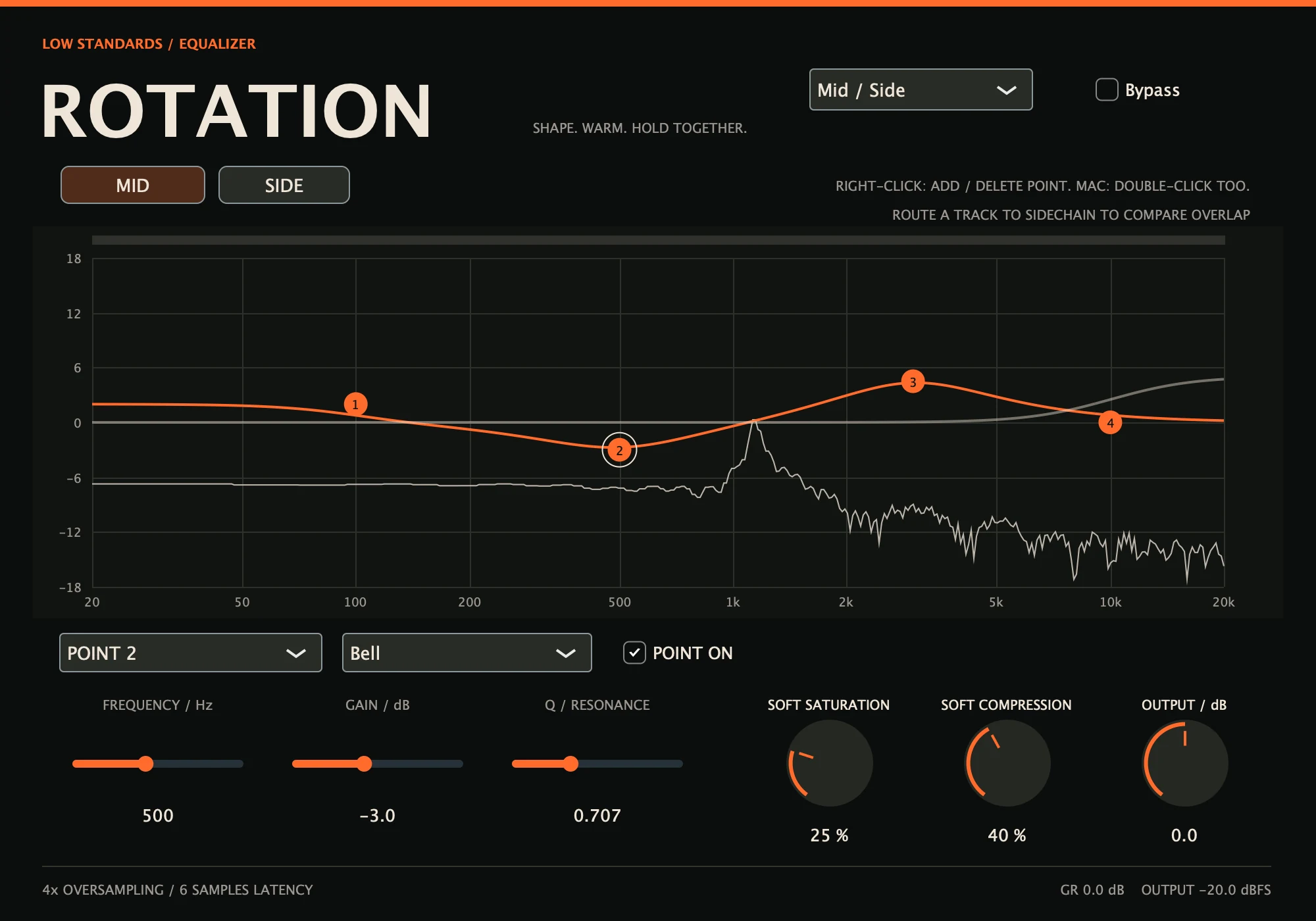
16 POINTS PER BANKBell, low/high shelf and high/low-pass filters. Right-click to add or delete; Mac also supports double-click. The left/right graph edges create high/low-pass points.
A familiar EQ curve with a little more underneath. Shape the center and sides independently, add soft saturation, and settle the dynamics.
Hear it in action ↓Coming soon. $20 for the individual plugin.
The same loop: original, EQ, then EQ with saturation and compression.
Choose a setting, then press play.
These demos are not loudness matched. Settings can change level as well as tone.
Playback could not start. Use the play button, or open the audio file.
Bell, low/high shelf and high/low-pass filters. Right-click to add or delete; Mac also supports double-click. The left/right graph edges create high/low-pass points.
Watch the spectra while shaping the EQ. Route another track to the sidechain to compare frequency overlap: orange for low overlap, lighter red for moderate and vivid red for high.
Add oversampled saturation and gentle stereo-linked compression. Match levels with Output and check the whole mix.
Built for your DAW.
Made by Low Standards.
Right-click the graph to add or remove a point; a normal click selects and drags. Choose Stereo or Mid / Side and edit up to 16 points in each bank. Route a comparison track to the external sidechain to see overlap, then make EQ decisions by listening.
No. The strip indicates simultaneous spectral energy, weighted by signal level. It is not a perceptual masking verdict and does not prescribe an EQ move. A grey strip means no connected/recent comparison data.
The bold curve is EQ gain. The thinner traces show input, output and sidechain spectra on a separate normalized −90 to 0 dBFS display scale. The EQ axis labels do not measure those spectrum traces.
With gains at zero, no active pass filters, Saturation/Compression at zero and Output at unity, audio uses the original dry samples delayed by the reported oversampling latency.
The ratio rises to 2:1, with a −12 dB threshold, 6 dB knee, 20 ms attack and 120 ms release. There is no automatic makeup gain or brickwall limiter.
Development builds include Mac AU and VST3 for Apple Silicon and Intel, and Windows x64 VST3. Direct audio-engine and processor checks have passed. September 2026 development revision. Automated DSP/processor checks and isolated Mac AU/VST3 load checks passed. Native Windows and REAPER/Ableton testing, signing/notarization and final delivery checks remain before sale.
The individual plugin will be $20. Sales open after final release checks.
Individual plugin optionsYour purchase will include a serial for up to three active computers. Deactivate an old computer to free a slot. Connect once to activate your serial, then use the plugin offline—even after restarting your DAW. Internet is needed again only to activate another computer or deactivate a slot.
Checkout opens after final release checks.